Pectoralis major or minor muscle and associated tendons
Common causes
Heavy lifting, sudden forceful movements and sports injuries
Symptoms
Chest or upper arm pain, bruising, weakness and possible muscle deformity
Diagnosis
Clinical examination, with ultrasound or MRI if required
Treatment
Rest, physiotherapy or surgical repair for selected tears
Recovery
Several weeks to months, depending on the extent of injury and treatment.
What is a pectoralis muscle tear?
The chest contains two main pectoral muscles: the pectoralis major and pectoralis minor. The larger pectoralis major supports movements such as pushing, bringing the arm towards the body and rotating it inwards. Beneath it, the smaller pectoralis minor helps stabilise and move the shoulder blade.
A pectoralis muscle tear occurs when the muscle or its tendon is partially or completely disrupted, typically following a sudden or excessive load. Most injuries involve the pectoralis major, particularly near its tendon attachment to the upper arm or the muscle-tendon junction.
Tears involving the pectoralis minor are much less common. They can cause discomfort around the upper chest or front of the shoulder, sometimes resembling other shoulder conditions.
What are the types and locations of pectoralis muscle tears?
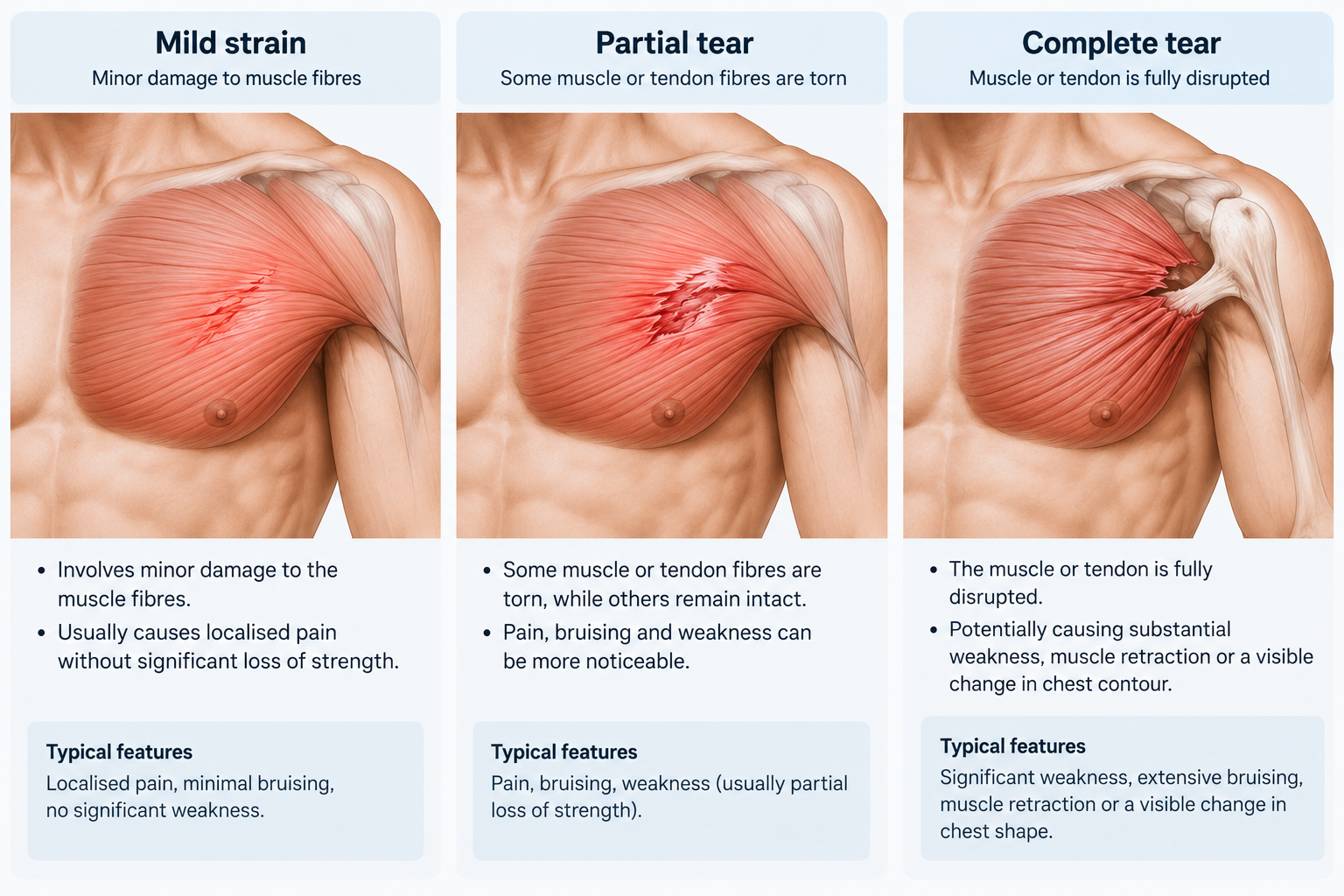
Pectoralis muscle injuries range from mild strains involving minor fibre damage to partial and complete tears that can cause weakness and changes in chest contour.
Pectoralis muscle tears are classified by the extent of tissue damage and where the injury occurs. These distinctions help determine how the injury is managed.
Types of pectoralis muscle tears
Mild strain — Involves minor damage to the muscle fibres, usually causing localised pain without significant loss of strength.
Partial tear — Some muscle or tendon fibres are torn, while others remain intact. Pain, bruising and weakness can be more noticeable.
Complete tear — The muscle or tendon is fully disrupted, potentially causing substantial weakness, muscle retraction or a visible change in chest contour.
Where can a pectoralis tear occur?
Tear location
Description
Muscle origin
Where the muscle attaches to the chest wall and breastbone. Tears in this area are uncommon.
Muscle belly
Within the main muscular portion of the pectoralis major or minor.
Muscle-tendon junction
Where the muscle fibres transition into tendon.
Tendon
Within the tendon itself, without complete detachment from the bone.
Tendon attachment
Where the tendon connects to bone. Pectoralis major tears frequently involve its attachment to the upper arm bone (humerus).
Pectoralis major tendon tears, especially complete detachments from the humerus, often warrant surgical assessment because of their potential impact on strength and function. Injuries involving the pectoralis minor are considerably rarer.
What causes a pectoralis muscle tear?
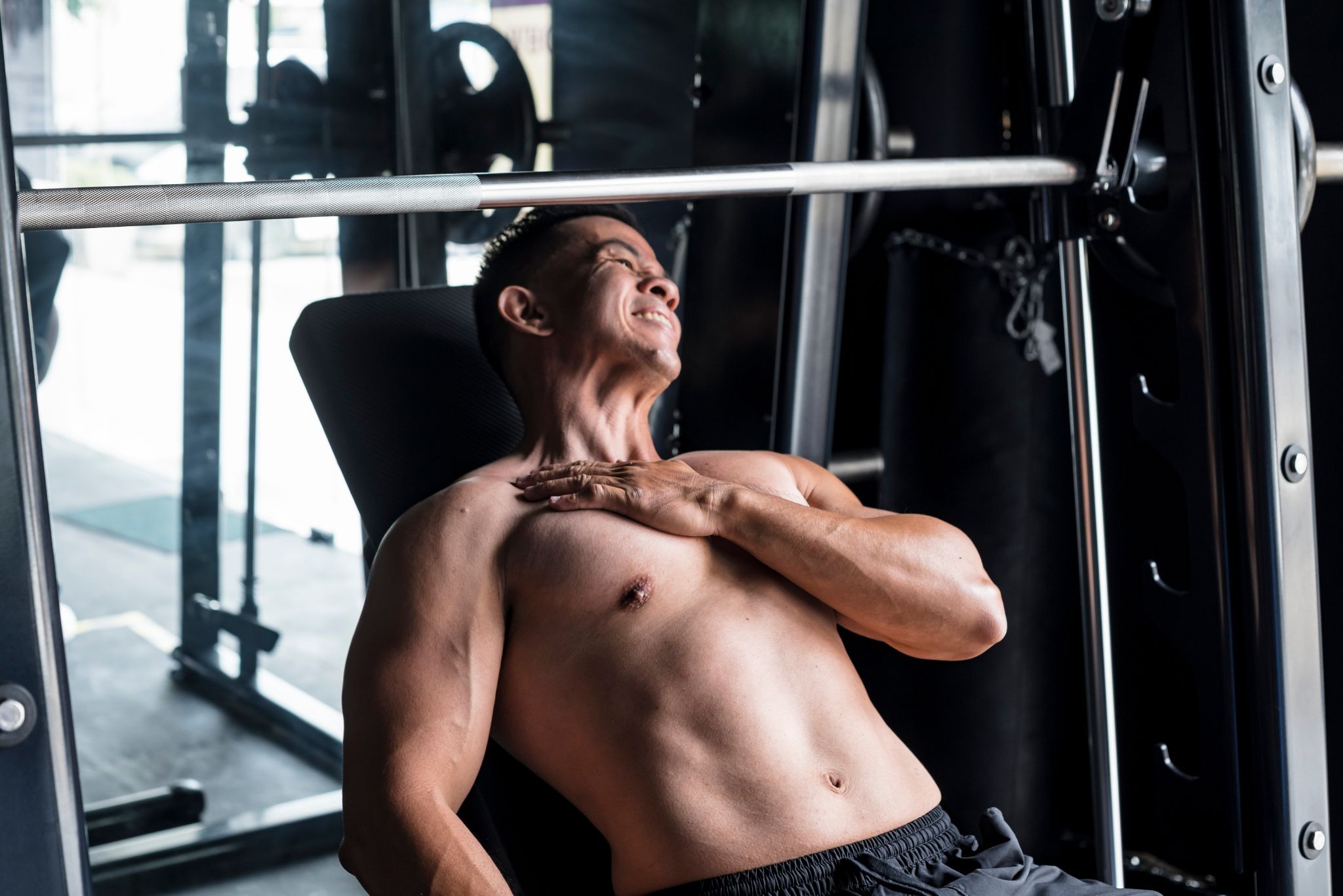
Pectoralis muscle tears typically occur when the muscle or tendon is subjected to a force beyond what it can withstand. Most pectoralis major tears happen during an eccentric contraction, where the muscle lengthens while resisting a heavy load, such as when lowering a barbell during a bench press.
Other causes include:
Sudden forceful movements — Explosive pushing or throwing motions can place excessive strain on the chest muscles.
Forced stretching of the arm — An unexpected backward or outward movement of the arm, particularly while the muscle is contracting, can result in a tear.
Contact sports injuries — Tackles, falls or direct impacts can damage the muscle or tendon.
Repetitive overload — Frequent chest and shoulder exercises without sufficient recovery can contribute to muscle strain, although complete ruptures are more commonly associated with sudden, forceful loading.
Pectoralis minor tears are considerably less common and have been reported following sporting injuries or unusual forces acting on the shoulder.
Who is at risk of a pectoralis muscle tear?
Pectoralis muscle tears are most common among physically active men, particularly those who participate in weightlifting or sports that involve forceful upper-body movements.
Factors that increase the risk include:
Heavy weightlifting — Bench presses, especially when lowering heavy weights, place considerable strain on the pectoralis major tendon.
Contact sports — Rugby, wrestling and other contact sports can involve sudden forces that overstretch the chest muscle.
Sudden increases in training intensity — Increasing weights or training loads too quickly can place excessive stress on the muscle and tendon.
Previous pectoralis injuries — A history of muscle or tendon injury can increase vulnerability, particularly if strength and function have not fully recovered.
Anabolic steroid use — Anabolic steroids are associated with an increased risk of tendon rupture.
What are the symptoms of a pectoralis muscle tear?
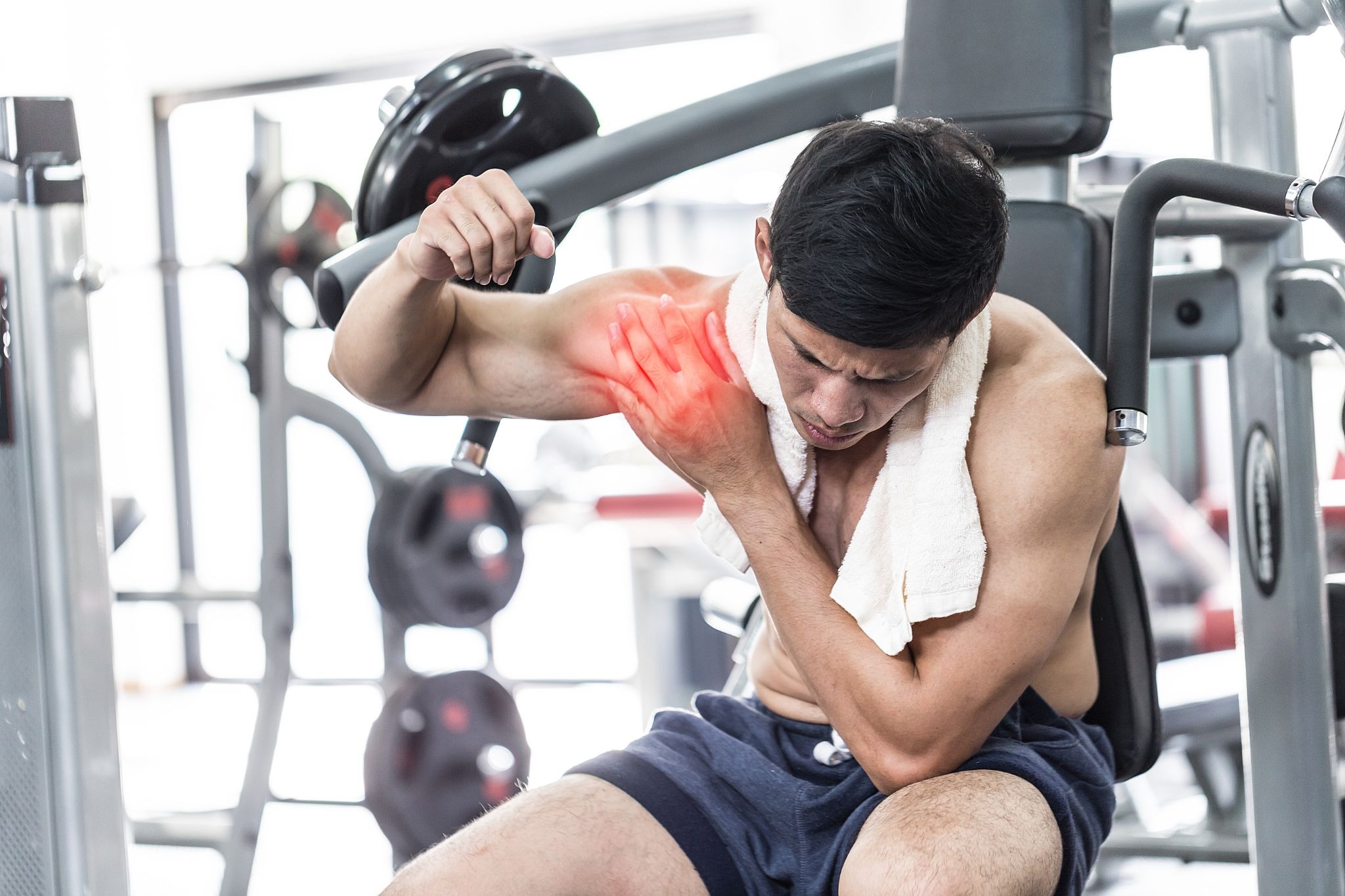
A pectoralis muscle tear typically causes sudden pain in the chest or front of the shoulder at the time of injury. The symptoms can differ depending on which muscle is affected and the extent of the damage.
Common signs and symptoms include:
Sudden sharp pain in the chest, armpit or front of the shoulder.
A popping or snapping sensation when the injury occurs.
Swelling and bruising across the chest, armpit or upper arm.
Muscle weakness, especially when pushing, lifting or rotating the arm inwards.
Tenderness around the injured muscle or tendon.
Visible changes in chest contour, such as a dent, asymmetry or loss of the normal armpit fold, particularly with complete pectoralis major tears.
Pectoralis minor tears generally cause pain closer to the front of the shoulder or upper chest, sometimes with tenderness near the coracoid process. As these symptoms can resemble other shoulder conditions, a clinical examination is important to identify the source of the injury.
Can you move your arm with a pectoralis muscle tear?
A pectoralis muscle tear may cause sudden pain across the chest or near the shoulder, especially during lifting or forceful arm movement.
Yes, it is often still possible to move your arm, even with a significant pectoralis muscle tear. However, certain movements can feel painful or noticeably weaker, particularly those that engage the injured muscle.
Being able to move your arm does not necessarily mean the injury is minor. A clinical assessment is important if you experience sudden pain, weakness or visible changes in your chest following an injury.
How is a pectoralis muscle tear diagnosed?
Diagnosis begins with a review of how the injury occurred and a physical examination. The doctor will assess the chest and shoulder for tenderness, bruising, changes in muscle contour and loss of strength.
Imaging tests can provide further information about the extent and location of the injury:
Ultrasound — Can identify muscle or tendon damage, including fibre disruption, fluid accumulation and tendon retraction. It also allows the injured structures to be examined during movement.
Magnetic resonance imaging (MRI) — Provides detailed images of the muscle and tendon to establish the tear's location, extent and degree of retraction. For suspected pectoralis major tears, a dedicated MRI covering the chest muscle and tendon is generally more informative than a routine shoulder MRI.
What are the treatment options for pectoralis muscle tears in Singapore?
Treatment depends on the affected muscle, tear location and severity, as well as the individual’s activity level and strength requirements.
Conservative Treatment
Non-surgical treatment is commonly used for mild strains, suitable partial tears and most isolated pectoralis minor tears. It can include:
Rest and activity modification to protect the injured tissue
Ice and pain relief to manage early discomfort and swelling
Physiotherapy to restore movement and gradually rebuild strength
Progressive return to activity once pain, mobility and strength improve
Surgical Treatment
Surgery is considered mainly for complete pectoralis major tendon tears, particularly when the injury causes significant weakness or affects an active person’s ability to work, exercise or participate in sport.
During surgery, the torn tendon is reattached to the upper arm bone using fixation devices such as sutures, anchors or buttons. Tears at the muscle-tendon junction can require a different repair approach. Earlier assessment is helpful because tendon retraction and scarring can make delayed repair more complex.
How long does it take to recover from a pectoralis muscle tear?
The time it takes to recover from a pectoralis muscle tear largely depends on the extent of the injury and whether surgery is required.
Mild strains can improve within a few weeks, while more substantial partial tears can take several months to recover. During this period, rehabilitation focuses on gradually restoring movement and strength without placing excessive stress on the healing tissue.
Following surgical repair of a pectoralis major tendon, the arm is typically supported in a sling for several weeks before progressing through physiotherapy. A return to heavier lifting or sports commonly takes around 4–6 months, although full strength and recovery can take longer.
Returning to strenuous activity too early can increase the risk of reinjury, so progression should be guided by the treating doctor and physiotherapist.
Pectoralis tear treatment in Singapore
A pectoralis muscle tear can affect everyday activities, exercise and upper-body strength, particularly when the injury involves the pectoralis major tendon. While some tears respond well to conservative management, others require surgical assessment to address the damage and restore function.
At Cove Orthopaedic Clinic, Dr Sean Ng assesses pectoralis muscle injuries and recommends treatment based on the nature of the tear and the patient's functional needs. If you experience persistent chest or shoulder pain following an injury, schedule a consultation for an evaluation.
Frequently Asked Questions
Mild strains and some partial tears can heal without surgery, provided the injured tissue is given sufficient time to recover. However, a completely detached pectoralis major tendon is unlikely to reattach to the bone naturally. Surgical repair is often considered for active individuals who wish to regain upper-body strength and function.
It is best to avoid exercises that place stress on the injured chest muscle until the extent of the tear has been assessed. Lower-body exercises or other activities that do not aggravate the injury might still be possible, subject to medical advice.
A complete pectoralis major tear can cause a noticeable change in chest shape, extensive bruising or significant weakness. However, these signs are not always present. A physical examination, supported by ultrasound or MRI when necessary, can help determine whether the tear is partial or complete.
An unrepaired complete tendon rupture can result in persistent weakness, reduced performance during pushing movements or a visible difference between the two sides of the chest. Some individuals adapt well without surgery, but the potential functional consequences should be discussed with an orthopaedic specialist.
Yes, reinjury is possible, particularly if heavy lifting or strenuous activity resumes before the muscle or tendon has recovered sufficiently. Following a structured rehabilitation programme and gradually increasing training loads can help reduce this risk.
No. Although surgical repair is frequently recommended for complete pectoralis major tendon ruptures in active individuals, non-surgical management can be appropriate in selected cases. The decision also takes into account the tear's location, the patient's health and their functional requirements.
At Cove Orthopaedic Clinic, our utmost importance is in helping our patients maintain or regain the mobility that they deserve, all through excellent patient care right from the start.
Happy and satisfied patients are what keeps us going!
Consult Us Today
If you have further enquiries or would like to make an appointment at Cove Orthopaedic Clinic, simply fill in the form below or call us at +65 9631 7637 | +65 6475 7177