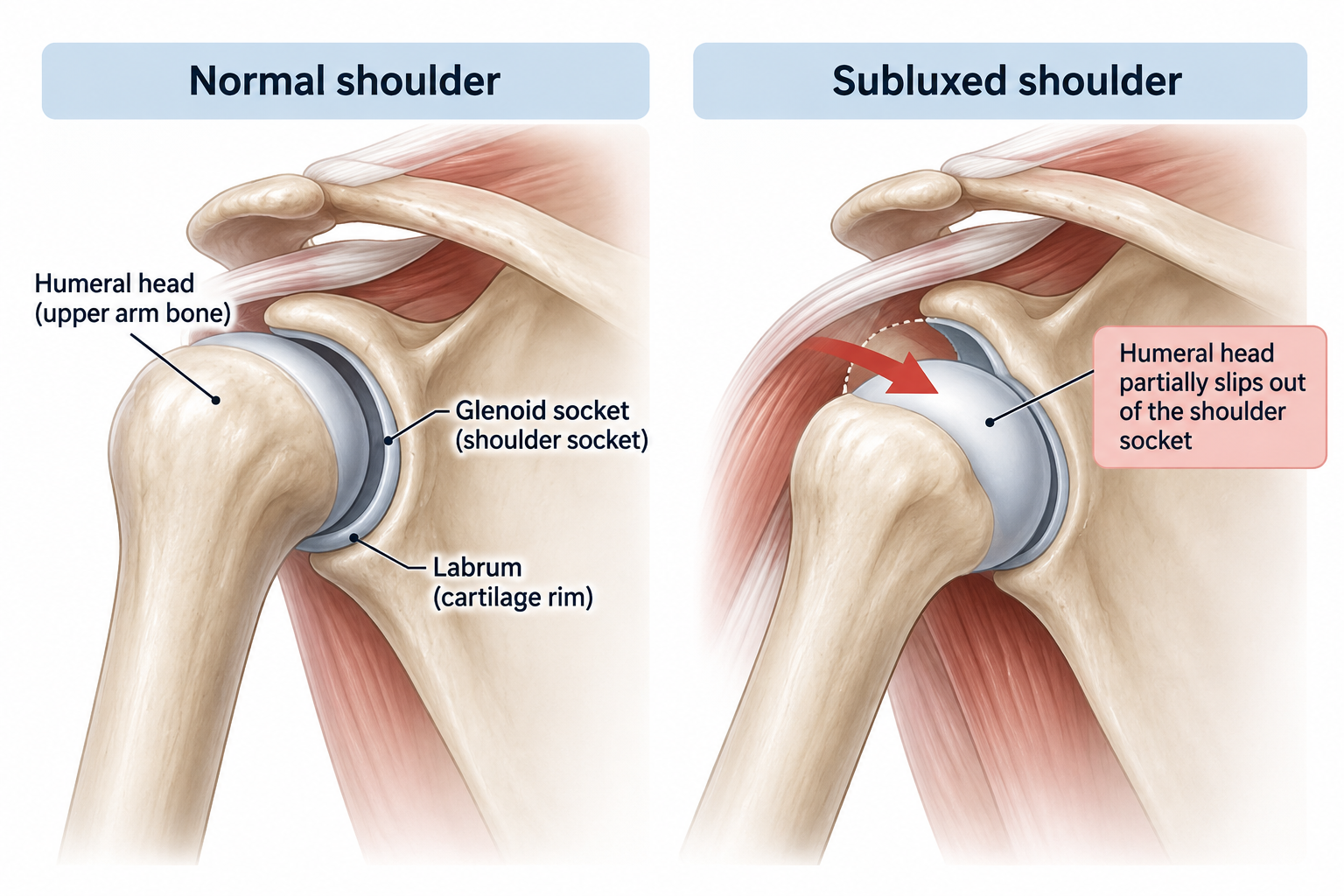
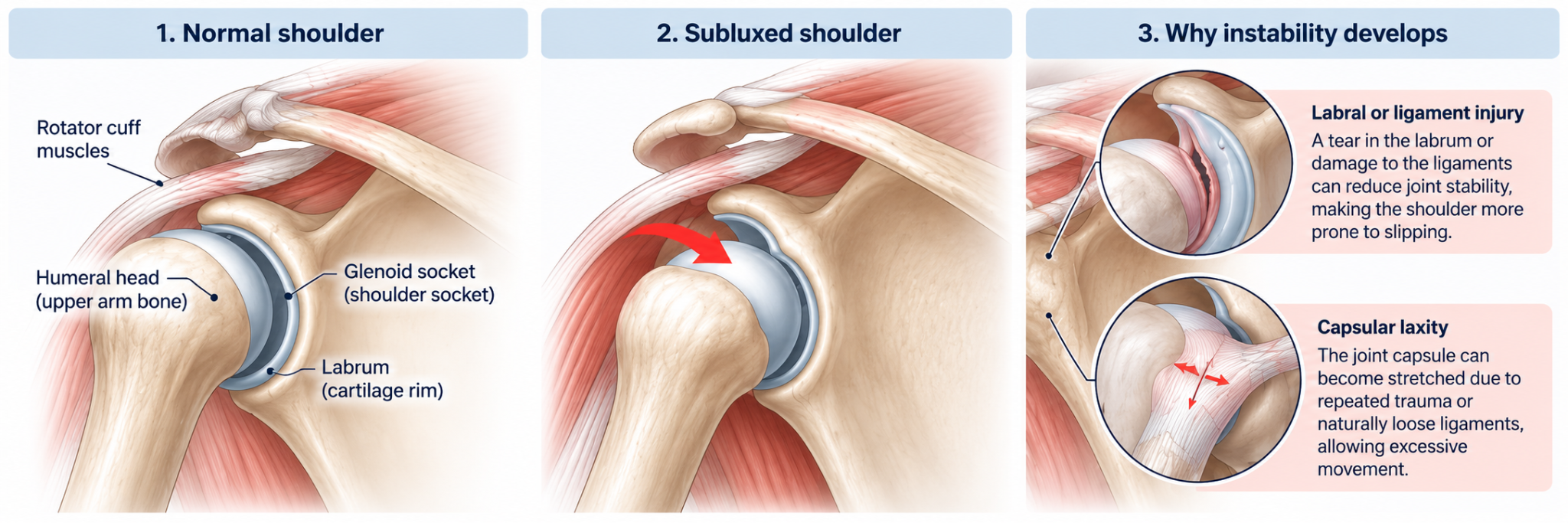
Shoulder joint, including the labrum, ligaments and joint capsule
Common causes
Previous shoulder injuries, ligament laxity, joint hypermobility and repetitive stress from overhead activities.
Symptoms
Shoulder slipping or looseness, pain, weakness and recurrent instability
Diagnosis
Clinical examination, with X-rays, MRI or CT scans if required
Treatment
Physiotherapy, activity modification or shoulder stabilisation surgery
Recovery
Several weeks to months; longer rehabilitation following surgery
What are shoulder subluxation and instability?
Shoulder subluxation occurs when the head of the upper arm bone (humerus) partially slips out of the shoulder socket. Unlike a complete shoulder dislocation, where the joint surfaces lose contact entirely, a subluxation involves partial displacement and can return to its normal position on its own.
Shoulder instability is a broader term describing a shoulder that is unable to maintain its normal position securely during movement. People with this condition may experience a sensation of looseness, repeated subluxations or dislocations, or apprehension that the shoulder might slip out of place.
How do shoulder subluxation and instability occur?
Shoulder instability can develop when the labrum, ligaments or joint capsule become damaged or stretched, making the humeral head more prone to slipping partially out of the shoulder socket.
The shoulder is a highly mobile joint, with the rounded head of the upper arm bone resting in a relatively shallow socket. To keep it in position, the joint relies on the labrum, ligaments, joint capsule and surrounding muscles.
A shoulder subluxation happens when the humeral head moves partially out of the socket. This can occur following a sudden injury, such as a fall or collision, or during movements that place excessive stress on the joint.
Shoulder instability develops when the structures responsible for keeping the joint centred become damaged, stretched or unable to provide sufficient support. For example, a previous dislocation can injure the labrum or ligaments, making subsequent slipping episodes more likely.
In other cases, instability develops without a significant injury. People with naturally loose ligaments or generalised joint hypermobility can experience excessive shoulder movement, while poor muscle coordination can make it harder to maintain joint stability.
What are the symptoms of shoulder subluxation and instability?
The symptoms of shoulder subluxation and instability can range from occasional discomfort to repeated episodes of the shoulder slipping out of position. Some people experience symptoms only during certain activities, while others notice instability during everyday movements.
Common symptoms include:
Sensation of slipping or shifting — A feeling that the shoulder is moving out of place, particularly during certain arm movements.
Shoulder pain — Discomfort during lifting, reaching or movements that place stress on the joint.
Recurrent subluxation episodes — Repeated instances of the shoulder partially slipping out of its socket before returning to position.
Weakness or reduced confidence in the arm — Difficulty performing certain activities or hesitation when moving the shoulder into positions that feel unstable.
Clicking or catching sensations — Some individuals notice clicking, catching or unusual movement within the joint, although these symptoms are not specific to shoulder instability.
How are shoulder subluxation and instability diagnosed?
Diagnosing shoulder subluxation and instability involves assessing how the shoulder moves, identifying previous injuries and checking for damage to the structures that support the joint.
The assessment typically includes:
Medical history — The doctor will ask about previous shoulder dislocations, episodes of slipping, and activities or movements that trigger symptoms.
Physical examination — The doctor assesses shoulder movement, strength and joint laxity. Specific tests, such as the apprehension and relocation tests, can help identify instability, while other assessments check for generalised joint hypermobility.
Imaging Tests
Imaging is not always necessary, but it can help identify structural injuries or bone abnormalities, particularly in patients with recurrent instability.
X-rays — Assess shoulder alignment and identify fractures or bony changes associated with previous dislocations.
Magnetic resonance imaging (MRI) — Examines the labrum, ligaments and surrounding soft tissues for tears or other injuries. An MR arthrogram may be recommended when more detailed assessment of the labrum is needed.
Computed tomography (CT) scan — Provides detailed images of the bones and can help assess bone loss involving the glenoid socket or humeral head, especially when surgery is being considered.
What are the treatment options for shoulder subluxation and instability?
Treatment for shoulder subluxation and instability aims to restore joint stability and reduce the likelihood of further slipping episodes. The doctor will consider whether the instability developed following an injury or is associated with joint hypermobility, as well as any structural damage and the patient's activity requirements.
Non-Surgical Treatment
Physiotherapy is often the first approach, especially for patients with mild instability or generalised joint laxity. Non-surgical treatment can include:
Activity modification — Temporarily avoiding movements or activities that repeatedly cause the shoulder to slip, while maintaining comfortable movement.
Physiotherapy — Strengthening exercises targeting the rotator cuff and shoulder blade muscles to improve joint stability and support a gradual return to normal activities.
Bracing or taping — External support can be used in selected cases during rehabilitation or sports, although it does not correct underlying structural injuries.
Pain relief medication — Suitable pain relievers or anti-inflammatory medication can be prescribed when necessary to manage discomfort during recovery.
Surgical Treatment
Surgery can be considered for recurrent instability, particularly following traumatic dislocations, or when significant damage to the labrum, ligaments or bone affects shoulder stability.
Arthroscopic Bankart repair
Reattaches a torn labrum to the shoulder socket and repairs associated capsular damage to improve stability, commonly for recurrent anterior shoulder instability.
Capsular plication
Tightens a stretched joint capsule to reduce excessive movement in selected patients with capsular laxity.
Latarjet procedure
Transfers a section of bone from the coracoid process to the front of the shoulder socket to improve stability. This is generally considered for patients with significant glenoid bone loss or other risk factors for recurrent instability.
Surgery is not necessary for everyone with shoulder instability. In patients with atraumatic instability or generalised hypermobility, structured rehabilitation is generally preferred before considering an operation.
Shoulder subluxation and instability treatment in Singapore
Shoulder instability can affect your confidence in everyday movements, especially when the joint repeatedly feels as though it might slip out of place. While some cases respond well to rehabilitation, recurrent subluxations or persistent instability warrant further assessment to identify any underlying structural injuries.
At Cove Orthopaedic Clinic, Dr Sean Ng provides assessment and treatment for shoulder subluxation and instability. If your shoulder continues to feel unstable or you have experienced repeated slipping episodes, schedule a consultation to discuss your symptoms and suitable treatment options.
Frequently Asked Questions
The main difference is how far the joint moves out of position. A subluxation involves partial displacement, while a dislocation involves complete displacement of the joint surfaces. Subluxations can resolve spontaneously, whereas complete dislocations often require medical assistance to restore normal alignment.
Yes. Many people with shoulder instability can still move their arm normally, although certain positions can cause discomfort or a sensation that the joint might slip. Movement can become more restricted following an injury or during an acute subluxation episode.
Mild shoulder instability can sometimes improve without surgery, particularly in people with joint hypermobility or no significant structural damage. Physiotherapy and targeted strengthening exercises can help improve shoulder stability and reduce recurrent episodes.
However, structural injuries such as labral tears can cause persistent instability and may require further treatment.
Recovery following non-surgical treatment can take several weeks to months, depending on the underlying cause and response to rehabilitation. Following stabilisation surgery, patients typically require several months of rehabilitation, with a return to contact or overhead sports often taking around 4–6 months or longer.
Persistent instability can lead to repeated subluxations or dislocations. In some patients, recurrent episodes cause further injury to the labrum, cartilage or surrounding bone, increasing the risk of long-term joint problems. However, not everyone with shoulder instability will experience progressive damage.
Not all cases are preventable, particularly when instability is associated with naturally loose ligaments. However, maintaining shoulder strength, using appropriate sports techniques and completing rehabilitation after an injury can help reduce the risk of recurrent episodes.
Surgery can be recommended when the shoulder repeatedly slips or dislocates despite rehabilitation, or when significant structural injuries are present. In selected young athletes with traumatic instability, early surgical stabilisation can also be considered because of the risk of recurrence.
Repeated dislocations and associated cartilage or bone injuries can increase the risk of shoulder arthritis over time. This does not mean everyone with shoulder instability will develop arthritis, but recurrent episodes warrant assessment.
Avoid movements that repeatedly trigger slipping or apprehension, particularly forceful overhead activities, heavy lifting and contact sports during early recovery. A physiotherapist or orthopaedic specialist can advise when it is appropriate to resume these activities.
Yes. Shoulder instability can occur alongside injuries such as labral tears, rotator cuff tears or other shoulder problems. A clinical assessment can help identify whether more than one condition is contributing to the symptoms.
At Cove Orthopaedic Clinic, our utmost importance is in helping our patients maintain or regain the mobility that they deserve, all through excellent patient care right from the start.
Happy and satisfied patients are what keeps us going!
Consult Us Today
If you have further enquiries or would like to make an appointment at Cove Orthopaedic Clinic, simply fill in the form below or call us at +65 9631 7637 | +65 6475 7177