Repetitive overhead movements, tendon changes and altered shoulder mechanics
Symptoms
Shoulder pain when lifting the arm, weakness and night-time discomfort
Diagnosis
Clinical examination, with X-rays, ultrasound or MRI if required
Treatment
Activity modification, physiotherapy, medication or corticosteroid injections
Recovery
Often improves over several weeks to months with appropriate rehabilitation
What is shoulder impingement?
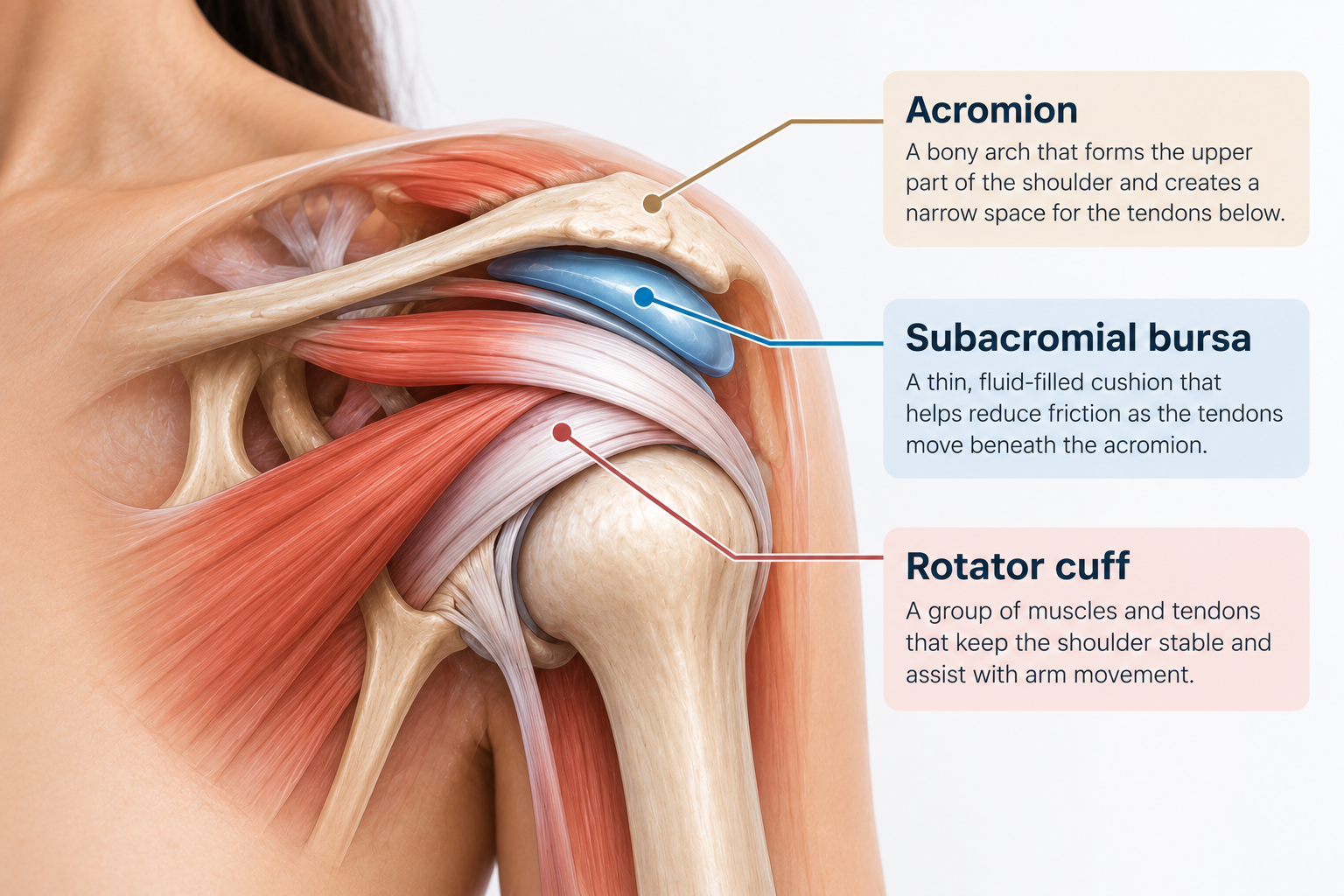
Shoulder impingement, also known as shoulder impingement syndrome, describes pain associated with irritation of the rotator cuff tendons or the subacromial bursa beneath the acromion, a bony projection at the top of the shoulder blade.
The condition commonly causes discomfort when lifting the arm, reaching overhead or performing repetitive shoulder movements. It is often associated with rotator cuff tendinopathy, bursitis or changes in how the shoulder moves.
Although traditionally attributed to compression of the soft tissues beneath the acromion, shoulder impingement is now understood to involve several contributing factors rather than mechanical compression alone.
What is the shoulder joint and what does it do?
The shoulder is a ball-and-socket joint formed by the upper arm bone (humerus) and the shoulder blade (scapula). Its structure provides a wide range of movement, from reaching overhead to rotating and lifting the arm.
The rotator cuff, acromion and subacromial bursa work together to support smooth shoulder movement. Irritation of the soft tissues in this region can contribute to shoulder impingement symptoms.
Several structures work together to support these movements:
Rotator cuff
A group of four muscles and their tendons that stabilise the shoulder and help control arm movement.
Acromion
A bony projection of the shoulder blade that forms a roof above the rotator cuff tendons.
Subacromial bursa
A small, fluid-filled sac that reduces friction between the rotator cuff tendons and the structures above them.
The rotator cuff tendons and subacromial bursa occupy the space beneath the acromion, where they move as the arm is raised and lowered.
What causes shoulder impingement?
Shoulder impingement is often associated with a combination of tendon changes, repetitive strain and altered shoulder movement. Rather than having a single cause, symptoms can develop when the rotator cuff tendons or surrounding tissues become irritated during everyday activities or exercise.
Common contributing factors include:
Repetitive overhead activity — Frequent lifting, throwing or reaching above shoulder level can place repeated stress on the rotator cuff tendons.
Rotator cuff tendinopathy — Degenerative changes or irritation of the tendons can contribute to shoulder pain, particularly during movements that load the affected tissues.
Altered shoulder mechanics — Reduced shoulder blade control or muscle weakness can change how forces are distributed across the shoulder during movement.
Bone spurs or structural changes — Changes in the shape of the acromion or surrounding bone can contribute to mechanical irritation in some individuals.
Previous shoulder injuries — Injuries affecting the rotator cuff or shoulder stability can alter movement patterns and contribute to persistent discomfort.
What are the symptoms of shoulder impingement?
Shoulder impingement often develops gradually, with pain felt around the front or outer part of the shoulder. Symptoms can also become noticeable following an increase in physical activity.
Common symptoms include:
Pain when lifting the arm — Discomfort during overhead movements or when reaching away from the body, sometimes occurring within a specific range of motion known as a painful arc.
Shoulder weakness — Difficulty lifting or holding objects due to pain or reduced rotator cuff function.
Night-time pain — Aching that interferes with sleep, especially when lying on the affected shoulder.
Tenderness — Discomfort around the shoulder, particularly when pressure is applied to the affected area.
Clicking or catching sensations — Some individuals notice these during shoulder movement, although they are not specific to impingement.
Symptoms can make everyday tasks such as getting dressed, reaching for items on a shelf or washing your hair uncomfortable.
How is shoulder impingement diagnosed?
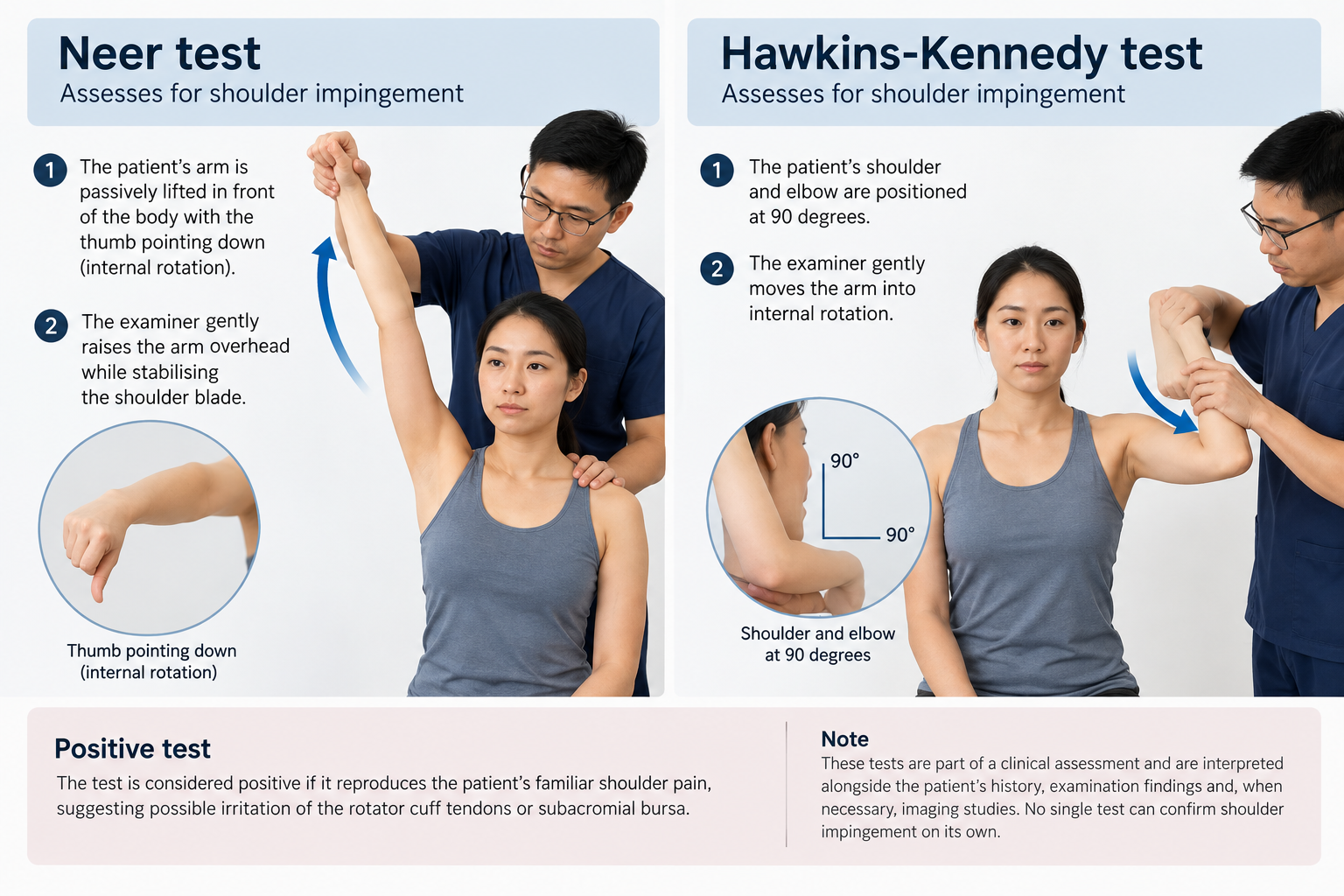
The Neer and Hawkins-Kennedy tests assess shoulder pain by placing the arm in specific positions to check for symptoms associated with shoulder impingement.
Diagnosis begins with a review of the patient's symptoms, medical history and activities that aggravate the shoulder pain. The doctor will then perform a physical examination to assess the shoulder's range of motion, strength and function.
Specific clinical tests, such as the Neer and Hawkins-Kennedy tests, can help identify movements that reproduce pain associated with shoulder impingement. However, these tests are interpreted alongside other findings, as no single test can confirm the condition.
Imaging may be recommended when symptoms persist or another shoulder condition is suspected:
X-rays — Assess the bones and joint for changes such as bone spurs, arthritis or abnormalities in the shape of the acromion.
Ultrasound — Examines the rotator cuff tendons and subacromial bursa for signs of tendinopathy, inflammation or tearing.
Magnetic resonance imaging (MRI) — Provides detailed images of the shoulder's soft tissues, particularly when a rotator cuff tear or another structural injury is suspected.
What are the treatment options for shoulder impingement in Singapore?
Treatment for shoulder impingement generally begins with non-surgical measures to relieve pain and improve shoulder function. The approach is guided by the patient's symptoms, activity requirements and any associated rotator cuff conditions.
Non-Surgical Treatment
Most individuals with shoulder impingement can be managed without surgery. Treatment options include:
Activity modification — Temporarily reducing movements that aggravate the shoulder while maintaining comfortable daily activities.
Physiotherapy — A structured rehabilitation programme involving rotator cuff strengthening, shoulder blade exercises to gradually restore mobility.
Pain relief medication — Short-term use of suitable pain relievers or non-steroidal anti-inflammatory drugs (NSAIDs) to manage discomfort, where medically appropriate.
Injection Therapy
Corticosteroid injections into the subacromial space can provide short-term pain relief when symptoms interfere with sleep, daily activities or rehabilitation. However, the effects are often temporary, and repeated injections require careful consideration because of potential risks to tendon health.
Surgical Treatment
Surgery is not routinely recommended for shoulder impingement alone. However, an orthopaedic specialist may consider surgery if investigations identify an associated structural injury, such as a significant rotator cuff tear.
If shoulder impingement occurs alongside a significant rotator cuff tear, surgical repair may be considered, particularly when pain and functional limitations persist despite non-surgical treatment.
Arthroscopic rotator cuff repair involves using a small camera and specialised instruments inserted through small incisions to reattach the torn tendon to the bone.
Shoulder impingement treatment in Singapore
Persistent shoulder pain should not be overlooked, especially when it begins to interfere with your usual activities. An orthopaedic assessment can help determine whether the discomfort is related to shoulder impingement or another underlying condition.
At Cove Orthopaedic Clinic, Dr Sean Ng provides assessment and treatment for shoulder impingement and related shoulder conditions. Schedule a consultation to discuss your symptoms and the appropriate next steps.
Frequently Asked Questions
Yes. Most people with shoulder impingement can still move their arm, although certain movements, especially lifting it overhead or reaching behind the back, can be painful. If you experience significant weakness or cannot raise your arm, further assessment is recommended to rule out other shoulder injuries.
Yes, mild cases can improve without medical treatment, especially when aggravating activities are reduced. However, if the pain persists, keeps returning or begins to affect everyday movements, an assessment can help determine whether further treatment is needed.
Some patients notice improvement within 6–12 weeks of consistent rehabilitation, although full recovery can take several months. The time it takes largely depends on how long symptoms have been present, whether other shoulder conditions are involved and how the shoulder responds to treatment.
Sleeping on your back or on the unaffected side is generally more comfortable. You can also place a pillow beneath the affected arm for support. Avoid lying directly on the painful shoulder if doing so aggravates your symptoms.
Some cases improve without medical intervention, while others develop persistent pain that interferes with sleep, exercise or everyday activities. Ongoing symptoms should be assessed, particularly if accompanied by increasing weakness or reduced movement, as another shoulder condition could be contributing to the pain.
Shoulder impingement is more common among people who regularly perform overhead activities, including athletes and those in physically demanding occupations. It can also affect older adults as the rotator cuff tendons undergo age-related changes.
At Cove Orthopaedic Clinic, our utmost importance is in helping our patients maintain or regain the mobility that they deserve, all through excellent patient care right from the start.
Happy and satisfied patients are what keeps us going!
Consult Us Today
If you have further enquiries or would like to make an appointment at Cove Orthopaedic Clinic, simply fill in the form below or call us at +65 9631 7637 | +65 6475 7177