Bunions, also known as hallux valgus in Singapore, are painful bony bumps that typically develop at the base of the big toe, specifically at the joint.
It is one of the most common foot deformities that develop slowly due to years and years of pressure that forces the big toe to be pushed inwards – towards the little toes. Over time, bunions grow bigger and stick out.There are several types of bunions, namely:
Congenital bunions: congenital bunions refer to bunions that are present since birth, as some babies are born with bunions.
Adolescent bunions: adolescent bunions are bunions that are formed in individuals who are aged 18 years old, and below.
Tailor’s bunions: formed at the base of your small toes (the pinky). They are usually formed due to improper shoe fitting or often engaging in activities that push the pink inwards.
Depiction of the progressive worsening of bunion.
What are the common causes of bunions in Singapore?
Bunion is a progressive foot deformity that is caused by inherited poor foot structure or foot type that makes a person more prone to developing bunions. Additionally, improper footwear has also been associated with the development of bunions. As pressure on the big toe joint leads to the big toe leaning towards the second toe, the normal position of the bones, ligaments, and tendons shifts. This deformity worsens over time, which causes pain when wearing shoes, or even walking. This is brought upon by the crowding, and altered mechanical forces in the ball of the foot.
Who is at risk of developing bunions in Singapore?
While anyone can develop bunions, certain individuals are more susceptible to developing bunions. These risk factors include:
1 Gender
Women are more at risk of developing bunions compared to men.
2 Active in sports
If you regularly participate in sports activities, including athletes, then you have a higher chance of developing bunions.
3 Bone or structural abnormalities
You are more susceptible to bunions if you are born with abnormal bone alignments in the feet or have structural deformities in your feet or legs.
4 Congenital defect
Some bunions are present since birth. Additionally, your risk of developing bunions is increased if your feet do not properly develop during the foetal stage.
5 Family history
You are more likely to develop bunions in your lifetime if you have parents who had bunions, or experienced any issues regarding their feet structure.
6 Footwear
If you have a habit of wearing shoes that are too pointed, too tight, or too narrow, then you are more likely to develop bunions.
7 Foot structure
Your risk of developing bunions is increased if you have low arch feet, or have an uneven weight-bearing (overpronation) in the foot, and tendon as it leads to the toe joints being unstable.
8 Health conditions
If you are diagnosed with rheumatoid arthritis or LUPUS, then you have an increased risk of developing bunions.
9 Hypermobility
You have an increased risk of developing bunions if your big toe moves too excessively.
10 Past foot injuries
If you experienced foot injuries in the past, then you are more at risk of developing bunions.
What are the common symptoms of bunions in Singapore?
One of the most telling signs of bunions is growth that develops at the base of your big toe that resembles or feels like a bony bump. Additional symptoms can include:
Burning sensation or pain when trying to bend the big toe.
Changes in the shape of the toes, and the feet.
Corns or calluses.
Difficulties wearing certain types of shoes.
Numbness around the big toe.
Pain that worsens when shoes are on.
Pain or stiffness in the big toe.
Painful toe tendons, and joints (hammertoes).
Skin discolouration or redness.
Swelling of the big toe.
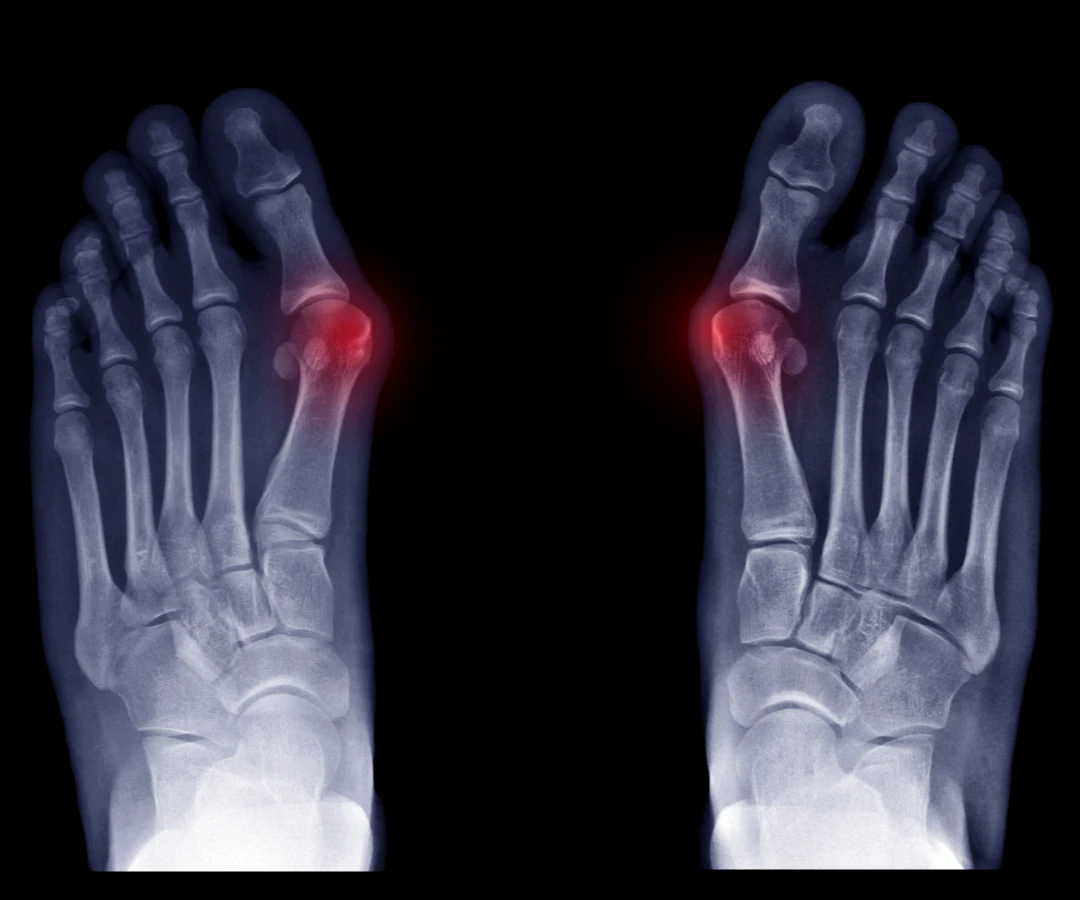
An x-ray can show the severity of bunions in detail, allowing orthopaedic specialists to decide on the best treatment plan.
How are bunions diagnosed in Singapore?
Our orthopaedic specialist is able to diagnose bunions through a visible inspection as symptoms are outwardly present. Additional diagnostic procedures could also include;
Range of motion tests: during a physical examination, you will be asked to move your toe back, and forth to observe the range of motion. Additionally, you may be asked to stand on your toes to determine your pain tolerance and flexibility. Our orthopaedic specialist will also check several areas around the toes, and the feet to identify any tenderness and source of pain.
Medical history: your prior diagnoses and family history will be evaluated to determine the root cause of bunion formation and to assign the appropriate treatment module that addresses the root cause.
Footwear assessment: it may be useful to bring your usual footwear (or images of) as this will help orthopaedists to determine if improper footwear is the root cause of bunion development.
X-ray imaging: if deemed necessary, an X-ray imaging is done to rule out the possibility of injuries, or deformities. It will similarly help in identifying the severity of the bunion.
How are bunions treated in Singapore?
As bunion is a foot deformity that progresses over time, it is important to seek treatment immediately. The treatment for bunions falls into 2 categories;
Non-surgical treatments: non-surgical treatments as a first line of defence to minimise bunion-induced damages and pain such as:
Add padding: adding padding to areas over the bunions can help reduce the pain.
Add shoe inserts: adding shoe inserts can ensure pressure is distributed evenly when you move your feet, thereby reducing pain, swelling and preventing bunions from worsening.
Change footwear: wearing footwear that fits properly, and has a wide toe box can reduce discomfort and pain, as well as prevent the condition from worsening.
Icing: applying an ice pack over the bunion areas can help reduce pain and inflammation.
Medications: ourorthopaedic specialist may prescribe oral nonsteroidal anti-inflammatory drugs (NSAIDs), like ibuprofen, to help in reducing the pain, and inflammation.
Orthotics devices: orthotics devices are customised devices that help in reducing the pain, and preventing pressure or friction from aggravating the bunions. These may include:
Readily available, or custom-made shoe inserts.
Toe spacers.
Toe splint.
Surgical treatments: surgery may be necessary, especially if nonsurgical treatments yield zero results. Bunion removal surgery, or a bunionectomy, is a minimally invasive procedure (keyhole surgery) that focuses on removing bunions and repairing any damages that may be present. Depending on the severity of your bunions, a surgeon may opt to perform 1 of the 3 following procedures:
Arthrodesis: an arthrodesis involves replacing the damaged joint with screws, and metal plates.
Exostectomy: an exostectomy involves removing bunions from the joint, without any surgical realignment.
Osteotomy: an osteotomy involves cutting your big toe joint to realign it to its normal position.
In cases of severe bunion progression, a traditional surgery may be necessary. Prior to initiating any treatment plan, our orthopaedic specialist will walk you through the procedure and inform you of possible risks, as well as the post-operative care tips that you are encouraged to follow.
At Cove Orthopaedic Clinic, our orthopaedic specialists are skilled, and experienced in diagnosing and treating bunions. Learn more about the treatment plans that we offer today.
Frequently asked questions
Untreated bunions will welcome complications, worsening pain, limited mobility, and more.
Yes, there are complications associated with bunions, such as:
Arthritis.
Decreased toe mobility.
Hammertoe.
Swelling of the fluid-filled pads that cushion the bones, muscles, and tendons (bursitis).
Swelling or pain in the ball of the foot (metatarsalgia).
Walking difficulties.
Unfortunately, no. Bunions tend to worsen over time. That is why it is important to see an orthopaedic specialist as soon as you experience any pain or swelling or find it difficult to wear shoes or walk.
Yes, it is possible for bunions to recur. Hence, our orthopaedic specialist often advises patients to adopt lifestyle changes, such as changing footwear, to prevent bunions from redeveloping.
Some of the preventive measures that you can practice are:
Choosing footwear that offers full, or maximum support.
Do foot exercises to stretch your muscles and tendons.
Maintaining a healthy weight.
Refraining from wearing high heels, or stilettos too frequently.
Wearing proper footwear with ample space for your toes to wiggle.
The moment your toes experience pain that becomes difficult to ignore, or limits your ability to walk, or even wear shoes, then it is time to have your toes and bunions examined. Some signs indicating the need for medical intervention include;
Progressive pain that does not resolve on its own.
Progressive deformation of the bunion (becomes larger).
At Cove Orthopaedic Clinic, our utmost importance is in helping our patients maintain or regain the mobility that they deserve, all through excellent patient care right from the start.
Happy and satisfied patients are what keeps us going!
If you have further enquiries or would like to make an appointment at Cove Orthopaedic Clinic, simply fill in the form below or call us at +65 9631 7637.