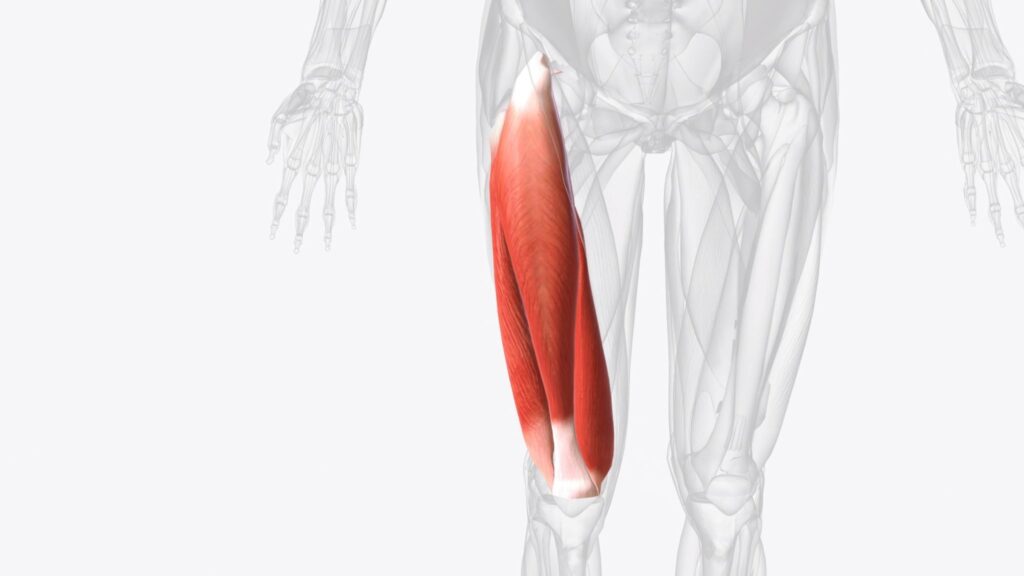
The Quadriceps femoris is the largest muscle in the human body.
It is a knee extensor and a hip flexor, made up of four separate muscles: three vastus muscles and the rectus femoris. They are located in the thigh’s anterior compartment, forming the main bulk of the thigh and are one of the most powerful muscles in the body.
Quadriceps muscle tears are injuries to the muscles at the front of the thigh, caused by overstretching or tearing of muscle fibres, leading to pain, swelling and weakness.
At a glance
Condition
Quadriceps muscle tear (thigh muscle tear)
Symptoms
Pain, swelling, bruising, weakness and reduced mobility
Common causes
Sports injuries, sudden force, overstretching and direct trauma
Who is at risk?
Athletes, active individuals and older adults
Diagnosis
Physical examination with ultrasound or MRI when required
Treatment options
Conservative management for most tears; surgery for selected severe injuries
A quadriceps muscle tear is an injury involving one or more of the muscles at the front of the thigh. It occurs when the muscle fibres are overstretched or torn, ranging from a mild strain affecting only a small number of fibres to a complete tear involving significant disruption of the muscle. Because the quadriceps muscles play an essential role in straightening the knee, supporting movement and bearing weight, an injury can reduce strength, limit mobility and make everyday activities more difficult.
Quadriceps muscle tears commonly occur during activities that require sudden acceleration, jumping, kicking or rapid changes in direction, particularly in sports and other high-impact activities. Symptoms may develop immediately after the injury or worsen over the following hours, depending on the severity of the tear. In more significant injuries, pain, weakness and reduced mobility can interfere with walking, climbing stairs and other daily activities.
What is the quadriceps muscle and what does it do?
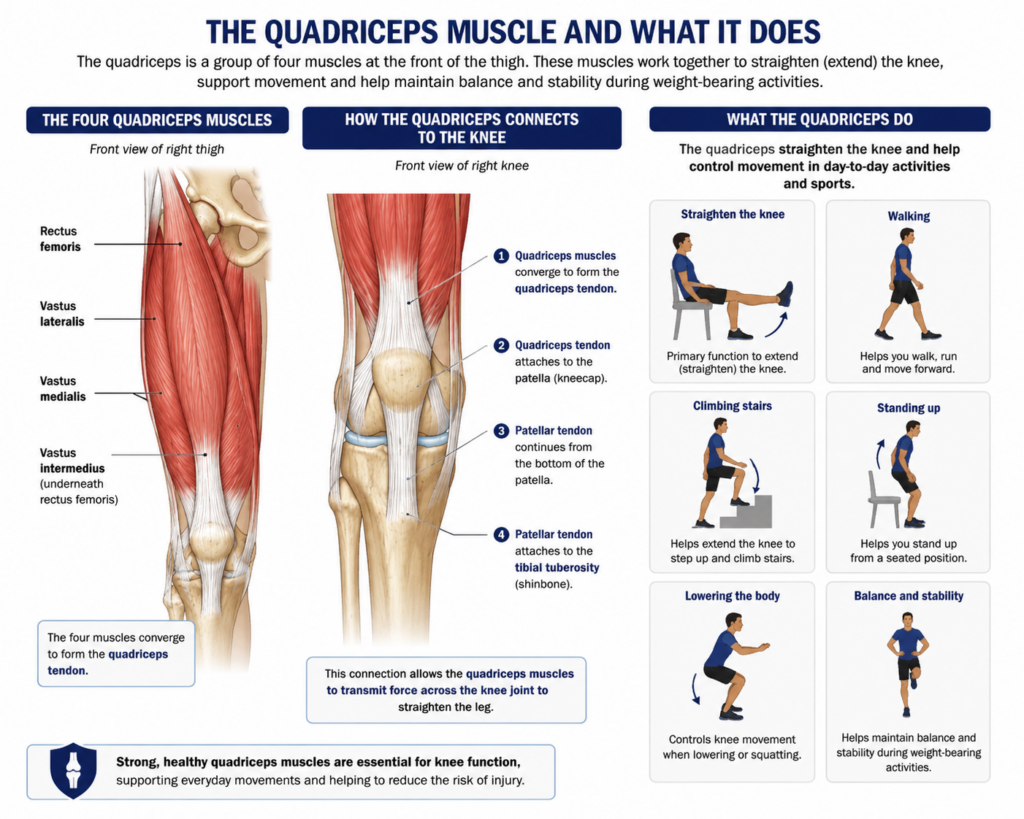
The quadriceps consists of four muscles, the rectus femoris, vastus lateralis, vastus medialis and vastus intermedius that work together to straighten the knee and support movement.
The quadriceps is a group of four muscles located at the front of the thigh: the rectus femoris, vastus lateralis, vastus medialis and vastus intermedius. Together, these muscles form the quadriceps tendon, which attaches to the kneecap (patella) and continues via the patellar tendon to the shinbone (tibia), allowing force to be transmitted across the knee joint.
The primary function of the quadriceps is to straighten (extend) the knee, enabling movements such as walking, running, climbing stairs and standing up from a seated position. The muscles also help control knee movement when lowering the body, absorb forces during activities such as landing from a jump, and contribute to balance and stability during weight-bearing activities.
What causes a quadriceps muscle tear?
Quadriceps muscle tears usually occur when the muscle is subjected to excessive force, rapid movement or inadequate support.
Sudden force or strain — activities such as sprinting, jumping or kicking place high demand on the quadriceps, particularly during explosive movements. These forces can exceed the muscle’s capacity, leading to tearing.
Direct trauma — a direct blow or impact to the thigh, such as during contact sports or accidents, can cause damage to the muscle fibres and result in a tear.
Overstretching — rapid or forceful movements that stretch the muscle beyond its normal range can lead to injury, especially if the muscle is not adequately prepared or warmed up.
Muscle fatigue or imbalance — weakness, poor conditioning or imbalance between muscle groups can reduce the ability of the quadriceps to handle stress. This increases the risk of injury, particularly during repetitive or high-intensity activity.
What are the symptoms of a quadriceps muscle tear?
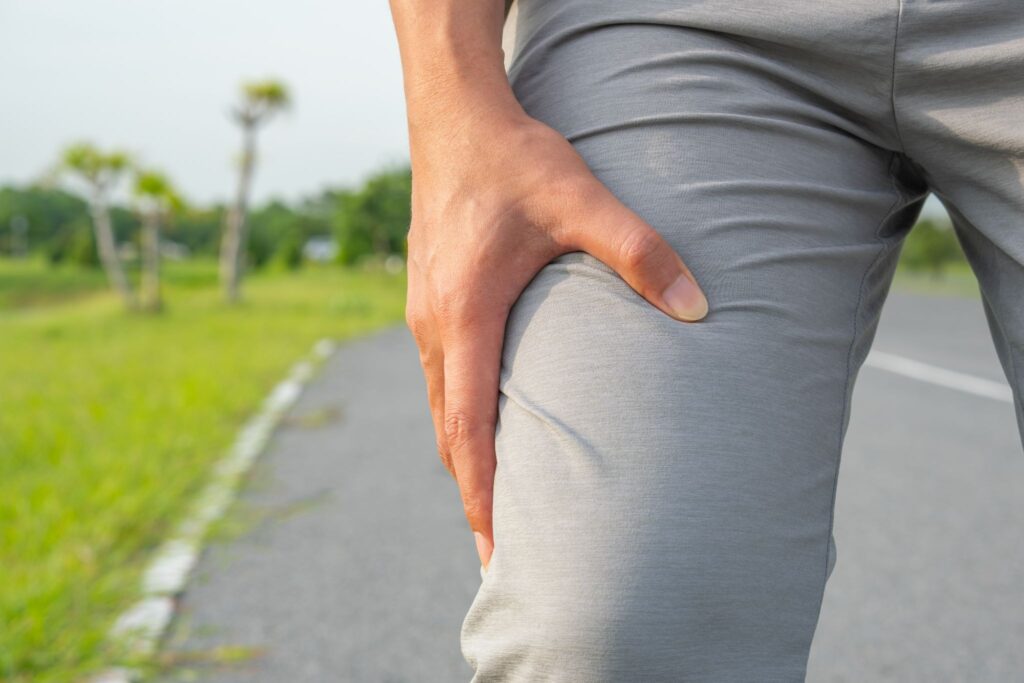
A quadriceps muscle tear may cause pain in the front of the thigh, especially during movement or when the muscle is stretched or used.
The symptoms of a quadriceps muscle tear depend on the severity of the injury but typically involve pain, swelling and reduced function of the leg.
Sudden pain in the front of the thigh — a sharp or tearing sensation may be felt at the time of injury, often during a forceful movement such as sprinting or kicking.
Swelling and bruising — the affected area may become swollen, and bruising can develop over time as bleeding occurs within the muscle.
Difficulty walking or bearing weight — pain and weakness in the thigh can make it difficult to walk normally or put weight on the affected leg.
Weakness in the leg — the ability to straighten the knee or generate force with the leg may be reduced, particularly in more significant tears.
Limited movement — stiffness and discomfort may restrict how far the knee can bend or straighten, affecting overall mobility.
How are quadriceps muscle tears graded?
Grade 1 (mild)
Small number of muscle fibres are overstretched or torn, causing mild pain with little loss of strength.
Grade 2 (moderate)
Partial tear with more significant pain, swelling, bruising and weakness.
Grade 3 (severe)
A complete tear through the muscle, causing significant pain, marked weakness, and sometimes a visible gap or bulge in the front of the thigh. Surgical repair may be required.
Is it possible to walk with a quadriceps muscle tear?
It is often possible to walk with a quadriceps muscle tear, particularly in mild or partial injuries. In these cases, individuals may still be able to bear weight, although movement is usually painful and limited. Walking may feel uncomfortable, and activities that require forceful use of the thigh, such as climbing stairs or standing up from a seated position, can become more difficult.
In more severe tears, especially when a larger portion of the muscle is involved, walking may be significantly impaired. There may be marked weakness, difficulty straightening the knee or an inability to bear weight on the affected leg. These signs suggest a more serious injury and should be evaluated promptly to determine the appropriate course of treatment.
Who is most at risk of quadriceps muscle tears in Singapore?
Quadriceps muscle tears are more likely to occur in individuals who place high or repeated demands on the thigh muscles.
Athletes — sports such as football, sprinting and jumping activities involve explosive movements that place significant strain on the quadriceps, increasing the risk of tearing.
Active individuals — regular participation in physical activity can expose the muscles to repeated stress, particularly if conditioning or recovery is insufficient.
Individuals with muscle imbalance — weakness or imbalance between muscle groups, such as between the quadriceps and hamstrings, can increase strain on the quadriceps and raise the risk of injury.
Middle-aged individuals — age-related changes in muscle flexibility and strength, along with reduced recovery capacity, can make the muscles more susceptible to tears during activity.
Older adults — age-related muscle and tendon degeneration increases susceptibility to tears, particularly during sudden movements or falls.
How is a quadriceps muscle tear diagnosed?
Diagnosis of a quadriceps muscle tear begins with a clinical assessment and is supported by imaging when needed to confirm the severity and exact location of the injury.
Clinical assessment — our doctor takes a detailed history of how the injury occurred, including the type of activity, whether there was a sudden onset of pain and how symptoms have progressed.
Physical examination — the thigh is carefully examined for localised tenderness, swelling and any visible bruising or muscle defect. Strength testing is performed to assess the ability to extend the knee against resistance, which helps identify weakness or loss of function.
Imaging (if needed) — imaging is used when there is uncertainty about the diagnosis or when a more detailed assessment of the injury is required.
Ultrasound — this is useful for identifying muscle tears, fluid collection and bleeding within the muscle. It provides a quick and dynamic assessment, particularly for more superficial injuries.
MRI — MRI offers a detailed view of the muscle and surrounding structures, allowing accurate evaluation of the size, depth and location of the tear. It is particularly helpful in distinguishing between partial and complete tears and in planning treatment.
What are the treatment options for quadriceps muscle tears in Singapore?
Treatment depends on the severity of the tear, with most cases responding well to conservative management. Surgical intervention is reserved for more significant injuries.
Conservative (Non-Surgical) Treatment
Rest and activity modification — reducing or avoiding activities that place strain on the quadriceps is essential in the early phase of healing. This allows the damaged muscle fibres to repair and prevents further tearing.
Ice and compression — ice application helps reduce pain and swelling, particularly in the first few days after injury. Compression supports the injured area, limits excessive swelling and may improve comfort during movement.
Physiotherapy — rehabilitation is a key component of recovery and is introduced in a phased manner. Early stages focus on gentle movement and reducing stiffness, followed by progressive strengthening and functional exercises to restore muscle performance and coordination.
Pain management — medications or supportive therapies may be used to control discomfort, allowing individuals to participate more effectively in rehabilitation. Pain control also helps prevent compensatory movement patterns that may delay recovery.
Surgical Treatment
Surgery may be recommended for severe quadriceps injuries, particularly when there is a complete tear of the quadriceps tendon, significant muscle retraction, or substantial loss of knee function that is unlikely to improve with conservative treatment. The decision depends on the location and extent of the injury, the patient's activity level and functional goals.
Muscle or tendon repair — This procedure involves repairing the torn muscle or reattaching the quadriceps tendon to restore continuity of the extensor mechanism of the knee. Surgery is typically considered when the injury is severe, the tendon has detached from the kneecap, or the torn muscle has retracted to a degree that limits natural healing. The aim is to restore knee strength and stability, improve function, and support a safe return to daily activities, work or sport following rehabilitation.
What can happen if a quadriceps muscle tear is left untreated?
If a quadriceps muscle tear is left untreated, the muscle may not heal properly, leading to ongoing pain and reduced function. Inadequate healing can result in weakness in the thigh, making everyday activities such as walking, climbing stairs or standing up more difficult. Over time, this may also affect movement patterns, as the body compensates for the injured muscle, potentially placing additional strain on other joints.
In more significant injuries, untreated tears can lead to persistent stiffness, loss of strength and an increased risk of reinjury. In some cases, the muscle may heal with scar tissue, which can limit flexibility and reduce performance.
How can quadriceps muscle tears be prevented?
Preventing quadriceps muscle tears involves preparing the muscle for activity and reducing the risk of excessive strain.
Proper warm-up — a thorough warm-up increases blood flow to the muscles and prepares them for activity, reducing the likelihood of sudden injury during high-intensity movements.
Strength and conditioning — regular strengthening of the quadriceps and surrounding muscle groups improves their ability to withstand stress. Balanced muscle development also helps maintain proper movement patterns.
Flexibility training — maintaining adequate flexibility allows the muscle to stretch and contract effectively without excessive tension. This reduces the risk of overstretching injuries.
Avoiding sudden strain — gradual progression in activity intensity and volume allows the muscle to adapt safely. Avoiding abrupt, forceful movements without preparation helps minimise the risk of tearing.
Summary
A quadriceps muscle tear is an injury affecting the muscles at the front of the thigh, most commonly caused by sudden force, overstretching or direct impact. Depending on the severity of the injury, it can cause pain, swelling, weakness and difficulty performing activities that require straightening the knee, walking or bearing weight. Injuries range from mild muscle strains to complete tears, and early diagnosis is important to support healing and reduce the risk of further damage.
Most quadriceps muscle tears can be managed successfully with conservative treatment, including rest, physiotherapy and a structured rehabilitation programme to restore strength, mobility and function. However, more severe injuries, such as complete tears or those associated with significant loss of function, may require surgical repair to achieve the best possible outcome.
If you are experiencing persistent thigh pain, weakness or difficulty walking after an injury, schedule a consultation with Cove Orthopaedic Clinic for a comprehensive assessment and a personalised treatment plan.
Conditions We Treat
Hip
Head
Hand & Wrist
Foot & Ankle
Elbow
Frequently asked questions
Yes, mild or partial tears can heal with rest and appropriate care. However, proper rehabilitation is important to restore strength and prevent recurrence.
Recovery time varies depending on severity. Mild tears may heal in a few weeks, while more significant injuries can take several months.
The terms are often used interchangeably. A strain usually describes a milder injury where the muscle fibres are overstretched or slightly torn, while a tear is often used for more significant partial or complete injuries. Both describe the same type of injury at different levels of severity.
Strenuous activity should be avoided initially. Gradual return to exercise is recommended under guidance once healing has progressed.
No, most tears are treated without surgery. Surgical repair is usually reserved for complete tears or cases with significant loss of function.
If not managed properly, it can lead to weakness, stiffness or an increased risk of reinjury. Early treatment helps reduce these risks.
Light walking may be possible in mild cases, but activity should be guided by symptoms and medical advice to avoid further strain.
Yes, recurrence is possible, especially if the muscle has not fully regained strength or if activity is resumed too quickly.
Yes. "Pulled muscle" is a common term for a mild quadriceps strain (Grade 1). While minor tears may feel similar to a pulled muscle, more significant tears often cause greater pain, swelling, bruising and weakness. A medical assessment can help determine the severity of the injury and whether imaging is required.
It depends on the severity of the injury and which leg is affected. Driving may not be safe if pain, weakness or reduced mobility affects your ability to brake or control the vehicle quickly. It is generally advisable to avoid driving until you can comfortably move your leg, bear weight safely and perform an emergency stop without pain or limitation.
Return to sport depends on the severity of the tear, the type of sport and how well the muscle has recovered. Mild injuries may allow a return within a few weeks, while more severe tears may require several months of rehabilitation. Returning too soon increases the risk of reinjury, so it is important to regain full strength, flexibility and function before resuming sporting activities.
Ice is generally recommended during the first 48 to 72 hours after injury to help reduce pain, swelling and bleeding within the muscle. Heat is usually introduced later in the recovery process, once the initial inflammation has settled, to help improve blood flow and prepare the muscle for stretching or rehabilitation exercises. Your doctor or physiotherapist can advise on the most appropriate timing based on your injury.
At Cove Orthopaedic Clinic, our utmost importance is in helping our patients maintain or regain the mobility that they deserve, all through excellent patient care right from the start.
Happy and satisfied patients are what keeps us going!
Consult Us Today
If you have further enquiries or would like to make an appointment at Cove Orthopaedic Clinic, simply fill in the form below or call us at +65 9631 7637 | +65 6475 7177