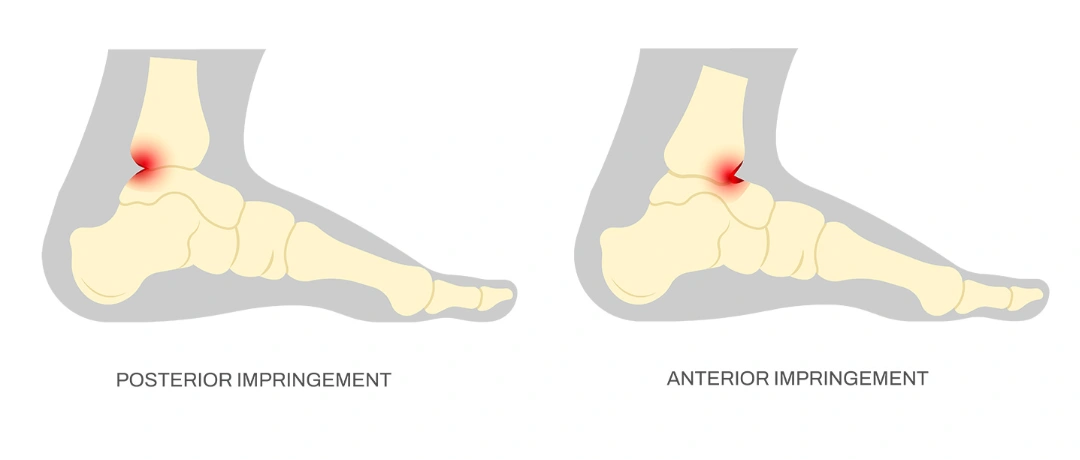
Ankle impingement is a condition where abnormal contact and compression of soft tissue or bone within the ankle joint lead to pain, stiffness, and restricted mobility. This often arises due to repetitive movements or following an injury, as inflamed or thickened tissues become trapped between the bones of the joint.
The condition is generally classified into two primary types:
Anterior Ankle Impingement — sometimes referred to as “footballer’s ankle,” this occurs when the tissues at the front of the ankle joint are compressed, particularly during upward foot movement (dorsiflexion). It is frequently seen in athletes who engage in repetitive kicking, running, or squatting.
Posterior Ankle Impingement — also known as “dancer’s heel,” this involves the back of the ankle joint, with tissues becoming pinched during downward foot movement (plantarflexion). Ballet dancers and individuals participating in activities requiring frequent toe pointing or jumping are especially prone.
Ankle impingement may develop as a result of repetitive strain, chronic inflammation, or previous injuries, such as ankle sprains or fractures. Over time, these factors can lead to the formation of scar tissue, bone spurs, or other structural changes that worsen the condition.
What causes Ankle Impingement?
Ankle impingement occurs when soft tissues or bones in the joint become compressed, causing pain at the front (anterior) during upward foot movement or at the back (posterior) during downward foot movement.
Ankle impingement occurs due to the abnormal compression of soft tissues or bone within the ankle joint during specific movements. This compression typically results from structural or functional changes in the ankle following repeated stress, trauma, or degenerative changes. Over time, these factors lead to the thickening of soft tissues, such as ligaments or joint capsules, or the formation of bony growths known as osteophytes. These changes reduce the space within the ankle joint, causing impingement when the joint is moved beyond a certain range.
In anterior ankle impingement, repetitive upward foot movement (dorsiflexion) compresses the tissues at the front of the joint, leading to pain and limited motion. Conversely, posterior ankle impingement occurs when downward foot movement (plantarflexion) causes soft tissue at the back of the joint to become trapped. Both types of impingement disrupt the normal mechanics of the ankle joint, contributing to inflammation, pain, and stiffness that worsen with continued movement.
What are the symptoms of Ankle Impingement?
Ankle impingement presents with a range of symptoms that vary depending on the type and severity of the condition. These symptoms often worsen with activities that involve repetitive ankle movements or extreme joint positions.
Pain — localised discomfort at the front (anterior) or back (posterior) of the ankle, often triggered by specific movements such as dorsiflexion or plantar flexion.
Swelling — visible puffiness around the ankle joint due to inflammation.
Stiffness — a sensation of restricted movement in the ankle, particularly during weight-bearing activities.
Tenderness — sensitivity to touch around the affected area.
Clicking or catching sensation — a feeling of the joint catching or locking during movement.
Limited range of motion — difficulty achieving full dorsiflexion or plantarflexion.
Instability — a sense of the ankle feeling unstable or prone to giving way.
Ankle impingement can cause localised discomfort at the front (anterior) or back (posterior) of the ankle, often triggered by specific movements.
Who is at risk of Ankle Impingement in Singapore?
Ankle impingement can affect individuals across various demographics, but certain factors and lifestyles common in Singapore may increase the risk of developing this condition. Below are some key risk factors:
Athletes — those involved in sports requiring repetitive ankle movements, such as football, basketball, ballet, or running.
Active individuals — people who frequently engage in high-impact activities, including hiking or gym exercises, which place stress on the ankle joint.
Previous ankle injuries — a history of ankle sprains, fractures, or ligament damage, which can lead to scar tissue formation and joint instability.
Occupational demands — jobs that require prolonged standing, climbing, or squatting, which place repetitive strain on the ankle joint.
Ageing population — individuals experiencing age-related joint wear-and-tear, as it increases susceptibility to bone spurs or tissue degeneration.
Foot anatomy issues — conditions such as flat feet, high arches, or accessory bones like the os trigonum, which can predispose the ankle to impingement.
How is Ankle Impingement diagnosed?
We use a combination of assessments and imaging techniques to identify ankle impingement and develop a treatment plan to your specific needs.
Comprehensive medical history — we take the time to discuss your symptoms, activity level, and any previous ankle injuries to understand the potential causes of your condition.
Physical examination — our specialists carefully assess your ankle for pain points, swelling, range of motion, and any signs of instability or tenderness during specific movements.
X-rays — these help us detect bony abnormalities, such as spurs or structural changes, that may contribute to impingement.
Magnetic Resonance Imaging (MRI) — we use MRI scans to gain detailed insights into soft tissue structures, such as ligaments, tendons, and cartilage, to confirm the diagnosis and rule out other conditions.
Ultrasound — when needed, this imaging technique provides real-time visuals of soft tissues and can help identify inflammation or impingement-related changes.
What are the treatment options for Ankle Impingement in Singapore?
Our personalised approach ensures that every patient receives the care best suited to their needs, so we can help them regain mobility and return to their daily activities.
Conservative management — at Cove Orthopaedic Clinic, we prioritise non-invasive methods where possible, including rest, activity modification, and the use of ankle braces to minimise strain on the joint.
Medication — we may recommend nonsteroidal anti-inflammatory drugs (NSAIDs) to reduce pain and inflammation, providing relief while the ankle heals.
Physical therapy — our team collaborates with expert physiotherapists to develop personalised exercise programmes aimed at improving ankle strength, flexibility, and range of motion.
Corticosteroid injections — for cases where inflammation is persistent, we use image-guided corticosteroid injections to target and alleviate discomfort effectively.
Minimally invasive surgery — if conservative treatments are insufficient, we specialise in arthroscopic surgery to remove scar tissue, bone spurs, or other impinging structures, which helps ensure a quicker recovery and reduced downtime.
Open surgery — in complex cases, our surgeons may perform open procedures to address more extensive issues, which helps provide a long-term solution for severe ankle impingement.
Summary
Ankle impingement is a condition that causes pain, stiffness, and limited ankle movement due to compression of soft tissues or bone within the joint. At Cove Orthopaedic Clinic, we provide a range of treatment options — from conservative care like rest, physiotherapy, and medication to advanced solutions such as corticosteroid injections and minimally invasive surgery.
Everyone goes through a different recovery journey, and our goal is to tailor our treatment plans to your needs to relieve discomfort, restore mobility, and support your return to daily activities. If you’re struggling with persistent ankle pain, schedule a consultation with us for a detailed assessment.
Frequently asked questions
Mild cases may improve with rest and activity modification, but persistent symptoms often require medical intervention for full recovery.
No, many cases respond well to conservative treatments like physical therapy and medication; surgery is considered when these methods are ineffective.
Recovery time varies; conservative treatment may take several weeks, while post-surgical recovery can extend to a few months.
It’s advisable to rest and avoid activities that exacerbate symptoms until you have consulted a healthcare professional for a proper treatment plan.
Anterior impingement causes pain at the front of the ankle during upward foot movement, while posterior impingement results in pain at the back during downward foot movement.
At Cove Orthopaedic Clinic, our utmost importance is in helping our patients maintain or regain the mobility that they deserve, all through excellent patient care right from the start.
Happy and satisfied patients are what keeps us going!
If you have further enquiries or would like to make an appointment at Cove Orthopaedic Clinic, simply fill in the form below or call us at +65 9631 7637.